Monday, June 30, 2014

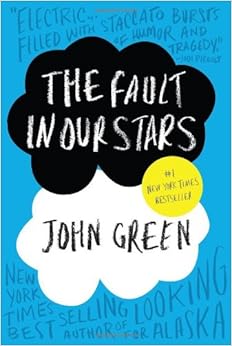
Book 11 -- The Fault in Our Stars by John Green

Nice Shakespeare reference there, John Green. I like it.

Spoilers ahead AS USUAL.

Context:

The Fault in Our Stars is the widely popular YA fiction about Hazel Lancaster, a sixteen year old girl with terminal lung cancer who hates going to her Support Group. That is, until Augustus Waters--an amputee with osteosarcoma--shows up and changes everything.

My Thoughts:

Well, I certainly didn't hate it.

On the good stuff:

I discuss my inability to believe in the characters later, but when they do sound believable, it's really good stuff. I especially like Hazel's reaction to correspondence from her favorite author: "WHAT IS LIFE!?" Someone's been on Tumblr.

I think he does a good job of capturing the pain and reality of cancer. I can't say this with certainty, because the only family member I've lost to cancer lived a state over from me, but it didn't feel like a Lifetime movie, at any rate. I like that he addresses how people are always painted as heroes when they die and how that's kind of bullshit--as if bad people don't die.

The Amsterdam trip was actually quite nice. I liked their little adventures. Very sweet, very emotional and thoughtful. The imagery was really lovely and kind of made me want to go to Amsterdam.

Andddd...the way she took care of him as he died was really sweet. Believable Mature Teenager moment. I felt really bad for Augustus at the gas station. 

Also:

"The world is not a wish-granting factory."

Accurate.

On the bad stuff:

Hazel and Augustus are the same person. The only difference between them is anatomy and Augustus's desire for his death to be a legacy. In that vein, they spout out these ridiculously philosophical quotes and metaphorical theories that are more befitting of the Wise Sage archetype than the Mature Teenager. I truly understand that these kids have been through some life-changing stuff, but going through something world-shaking like cancer doesn't suddenly give you the ability to quote classic literature in daily speech and reference obscure quotes that I, a 24-year-old grad student, have to Google (I'm thinking specifically of "sword of Damocles"--what the hell?). So much of it just sounds like he is trying very hard to wax philosophical and it usually doesn't work for me.

I also don't get the whole "great love" thing. What do they know about each other besides cancer and An Imperial Affliction? Do they ever have a conversation about anything else? I can't think of one.

Also...Van Houten, what the hell? While I liked his character development, the whole "him coming to America" thing was very, very weird and unbelievable to me.


My Rating: 2.5/5

Not an awful book by any means, but not particularly striking for me, either. Not a waste of time, but there are some really flat moments that stink of "trying too hard." Does handle cancer in a believable way, so if you like crying over the human condition, give it a shot.

Sunday, June 8, 2014

Book 10 -- The Body in the Library by Agatha Christie

Did you know that Agatha Christie is the most widely published author in the world, falling just short of Shakespeare and the Bible? Now you know!


Context:

The Bantrys wake to find the body of a young woman in their library. They don't know who she is or why she is there, but when another young girl is murdered nearby, the connection is clear: something foul is at play. Esteemed amateur sleuth and adorable old spinster Miss Marple is brought in by Mrs. Bantry to discover the truth of the situation before her and her husband's reputations are ruined by the affair.

My Thoughts:

I've never been much of a mystery girl, but I really enjoyed this novel.

First, I like the time period. I've always gotten a kick of  late Victorian and early 20th century language--you know, when they used to say "fantastic" to mean something wildly unimaginable, or "gay" to mean happy, and all that kind of stuff. It's also interesting to see how different it was solving crimes Back Then. Today we have television shows like CSI and SVU and other such things that give us ideas about how crime solving works, but they had far less technology in the period Agatha Christie wrote. The character of Miss Marple is something of a Sherlock Holmes, without the ramped up ego and label of Genius. It was interesting to see her suss out the details based on human observation and uncharacteristic cynicism of human nature. I think my fiance would like this book a lot. He prides himself on his observational skills, so I wonder if he'd be able to figure it out. I sure didn't. I was totally wrong.

Though one thing that annoyed me--due to my own personal issues rather than anything wrong with the novel--was Mrs. Bantry's obsession with how people talked about them. It was clearly emphasized how important public opinion was. And I get it. It's totally historically accurate. In today's society, we can afford to be independent and self-important; in the era which Christie wrote and wrote about, communities well and truly depended on each other for everything from employment to reliable professionals (for instance, you wouldn't want the only doctor in your small community to think poorly of you). And sure, some of it was superficial and more about socializing, but socializing was important, and could only be accomplished if certain social etiquette was observed. Nowadays, social etiquette isn't really important, at least not to the degree of propriety it used to be. It's an interesting way of living, but it just irritates me that so much importance had to be placed on other people's opinions.

I also really like Christie's tone. She has a sense of humor that is subtle, and her characters each have a distinct personality that doesn't feel forced or overly structured. There's also a point where she references herself--a young boy claims he has autographs from many mystery authors, and the boy names Christie as one of them. Teehee.

I also like her obvious feminism. Considering the book was published in 1942, it was rather daring of her to have so many women at the forefront of her novel. The detective who solves the crime is a woman; one of the murderers is a woman; the victims are women; and in fact, quite a number of the supporting cast are women. Each of these women is a character who would pass a novel version of the Bechdel test. I applaud your progressive stance, Agatha Christie!

The actual story was wonderful. I read this book in a day. I was fascinated by the storyline, and remember earlier in my blog when I mentioned how not many authors can pull off a twist without it feeling unoriginal or forced? Well, Christie is apparently the Mother of the Surprise Ending; I didn't expect her ending at all, and it didn't feel contrived, scripted, or forced in any way. She had me guessing from the get-go, and I loved every minute of it. Marple felt real;  unlike the well-loved Sherlock Holmes, whom we are supposed to simply accept as a savant, Marple is simply an old lady with a keen eye for detail and a cynical view of human nature. 

My Rating: 4.5/5

An extremely well written novel with believable characters, an intriguing plot, and a great pace. There's no real identifiable reason why I didn't quite feel this novel was a five; simply a feeling I had where I was intrigued, but not grabbed. I wasn't hooked, maybe because there wasn't a lot of action. It was mostly dialogue and descriptions of action. Perhaps if we could have seen one of the murders in action, cloaked in anonymity, it would have grabbed me more. 

Saturday, June 7, 2014

Book 9 -- Pictures of You by Caroline Leavitt

This was an adventure outside of my usual reading comfort zone. So let's hop to it!


Context:

Isabelle is running from her imploding marriage when she crashes her car into a woman who is running away as well. Isabelle must come to terms with what the accident does to her life, and simultaneously becomes entangled with the lives of the surviving husband and son.

My Thoughts:

At first, I didn't really care for this novel. I honestly felt like I was reading a cheesy country song (no offense, country music--I grew up on you and I love you dearly) for a little while. And the characters were infuriating. Maybe it wouldn't have been so maddening if the novel wasn't third person omniscient. At any rate, it's annoying to me that Charlie knows that April is a free spirit, acknowledges that she acts flighty and disconnected and likes to take random road trips, and then gets all confused when he doesn't keep the romantic spark alive and smothers her with suburban American life and she runs away. Well, duh.

I also felt really frustrated with the way things turned out. See, I'm a bit picky and weird and don't make a lot of sense. I really enjoy endings that break free from the norms (as in, not everything is a happy ending), but I still want the happy lovey romance stuff to work out in the end. So on the one hand, I'm happy that it was more realistic and it wasn't like "And Isabelle and Charlie lived happily ever after!" But it was also so obvious that Charlie and Isabelle always loved each other and that they settled with the people they ended up with. Excuses about Sam be damned, they could have made their way back to each other at some point. Or Charlie could have, you know, not been an ass and tried the whole long distance thing until Sam was stronger.

I don't know, I guess this is why I don't read romantic dramas a lot. I realize the novel is realistic in many aspects, and I do appreciate that, but I also craved something more for Isabelle and Charlie. I tried to be understanding of Isabelle's paranoia and clinginess, and of Charlie's wishy-washy, one foot in one foot out crap, but I just wanted to slap both of them.

Oh, and the final reveal about April--equal parts surprising and unsurprising. Like on the one hand, we already knew she wasn't planning on taking Sam with her, but to really know for sure that she was planning on leaving her family behind...yeah April was established as impulsive and flaky but to abandon your kid? Seriously lady? Getting the story from Bill was a nice surprise, and much needed closure. 

I did enjoy getting a POV from Sam, and it was really great when he finally realized his mother was really, truly dead. Such an emotional scene. I also enjoyed that the closing chapter of the novel was from an adult Sam's POV. I'm glad he got closure with Isabelle. 

Some of the themes were slap you in the face obvious, but the author has a really great style of writing, so despite the fact that I could see right through most of the metaphors, illusions, and themes, it didn't bother me too much because her beautiful writing eased me through it. 

My Rating: 3/5

A surprising read that takes a while to warm up to, Pictures of You explores some interesting themes and offers a creative, interesting story that actually feels fresh. If you're not a fan of romantic dramas, it may be hard to believe in the story, but the author's well-written characters and beautiful dialogue help ease the process along so that it doesn't feel like a Fabio-emblazoned stereotype.

Book 8 -- The Giver by Lois Lowry

I read this book in elementary school, and I don't think I really grasped it back then. So I re-read it in anticipation of the oncoming movie (which looks awful, by the way).


Context:

Jonas lives in the perfect world. Spouses and careers are hand-picked for each person; there is no war, pain, fear, or emotion whatsoever. However, when Jonas is selected to be the Receiver of Memory--a rare, prestigious honor--he learns that there used to be more to the world than his daily routine. 

My Thoughts:

Okay now I remember why I thought of this book when I read Divergent: the age ceremonies! Of course, the age ceremonies are more about assignments and the Choosing Ceremony is about choice, but still.

So anyways, I just really really love this book so much. 

I love how it's not your typical dystopian novel. Things are bad without being bad. Jonas doesn't even realize what a controlled world he's living in until he receives memories from the Giver. And this leads to an interesting discussion and moral conundrum: should people be allowed to make choices? What is the inherent value of these choices? This is something Jonas struggles immensely with and something I think would be fun to introduce into a classroom. 

On the one hand, you can't miss what you don't know. So Jonas's friends and family live in a world without love, color, music, weather, or career options--is that really so bad? As readers, we balk at the idea of someone taking away our emotions and the nuances of life--but only because we are so spoiled by them. They also have no heartbreak, no pain, no lies, no war, no illness. What's so wrong with that? Jonas would have lived a perfectly content life, never knowing any different had he not been selected as the Receiver of Memory.

And then, of course...we know that pain is what makes us human. Our ability to process and experience emotions and experiences and change based on what we learned is key to our identities. Without some sense of personal relevance, we are nothing more than robots. What is even the point of life if we all continue on the same structured, bland, neutralized path planned out by someone with our "best interests" in mind? Even if our choices end up being destructive, shouldn't we have the right to make those choices?

DO YOU SEE HOW FASCINATING THIS BOOK IS YET?

I just wish we had more back story. How did Jonas's world come to be this way? How many communities like Jonas's are there? Are there other communities with different rules? Is there still war and all those other things Jonas received memories of, and they're just sheltered from it somehow (much in the same way Chicago was a pocket unto itself in Divergent)? 

And the whole ending is just so freaking sad. I know Lowry has released sequel novels to The Giver that kind of explain what happens, but before that, the ending was just a huge question mark. Does Jonas and the baby die? I always thought they kind of did, because it was just so convenient how they 'stumbled' upon the exact scenario from Jonas's first memory. 

This is a very short book, but it's slammed full of interesting themes and fantastically written scenes. 

My Rating: 5/5

Hands down one of my favorite books I've ever read. The plot makes sense, the characters feel very real, and I love that it's a dystopian with a utopian face. Lowry creates an incredibly imaginative world that makes the reader question everything they know about the human experience. This is a book that will make you feel and think, and will leave a lasting impression on you.