Saturday, January 11, 2014

Book 3--Night by Elie Wiesel

I'm really irritated that it took me so long to finish this book and review it. It's just over 100 pages, so I could have/should have finished it in a day. In my defense, I started my graduate school program this week and have been doing a LOT of things. This schedule will take some adjusting to.

So my third book: Night
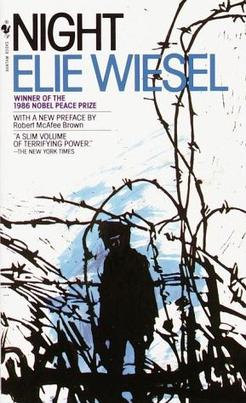

Context:

Elie Wiesel was 15 years old when his Jewish family was uprooted and dragged off to a concentration camp. This short but powerful autobiography chronicles his personal struggles and the horrifying abuses he endured by the Nazi party.

My thoughts:

I really enjoyed reading this autobiography. It's one of my favorite Holocaust books I've read. It's personal--unlike popular favorites like The Diary of Anne Frank, you get to see behind the fence and truly experience the horror. The title, "Night," is a perfect descriptor for the narrative--not only is it dark and terrifying, but the words "Night had fallen" are repeated numerous times throughout the semi-memoir. Elie is constantly aware of the night--physically and metaphorically. It's also symbolic of how he loses his faith in God--his faith becomes dark and silent. 

I was moved by his relationship with his father. It's interesting to see how so many boys turn on their fathers (one murders his father for a scrap of bread), but Eliezer stands by him until his horrific death. He refuses to leave him; no matter what happens, he's constantly thinking, "Where's my father?" As Elie states, it's easy to abandon all sense of humanity when your basic needs aren't being met; but for him, his father was his main reason for surviving.

It's also stunning to hear of the abuses the Nazis heaped on the Jews. Everyone knows that it was awful, but I believe we've become numb to what those horrors were like. We know they were experimented on, tortured, beaten, and starved, but it's too easy to remove ourselves from that since the vast majority of us have probably never experienced anything like that. This work, with it's beautiful and haunting prose, brings the reader into the Holocaust. Running 42 miles, the lack of food and water, the children being burned in a pit, men being hung for minor infractions...these horrors sent shivers down my spine. You can tell the author lived these things; how else could he so painfully recollect and retell these events? And God, were they brutal. Elie's description of his wounded foot, his father's suffering in the throes of death, and the horrible conditions of the trains and the barracks made me feel sick. How could any human look at another human being and inflict these cruelties on them? I hope I never have to find out.

The religious themes are also immensely fascinating to me. Most religious people try to praise God whether things are going well for them or poorly--however, when faced with senseless persecution, it's so easy to lose faith. I can't judge them for that. How could a loving, benevolent God stand by while his "chosen people" are murdered and tortured? Eliezer's experiences force him to question the cherished beliefs he once identified with. He does not completely abandon his faith, but it's interesting to watch him and the other Jews struggle with their lot in life. 

It's important to note that though I have been using Elie and Eliezer interchangeably, Elie Wiesel did change some minor details in the retelling of his story. He was silent about the Holocaust for about 10 years before he decided to write this Nobel Peace Prize winning story. This seems to be an effort on his part to continue to place some distance between himself and those events; and who can blame him? He lost everything in the Holocaust; his family, his identity, his dignity, most of his faith.

My Rating:

I give Night a 4.5/5

Elie Wiesel's autobiography is terrifying, haunting, and fascinating. His writing is absolutely gorgeous, and his emotion is tangible. Each scene leaps off the page and grabs the reader, forcing them to think about what the Holocaust actually was, as opposed to the desensitized textbook page it's usually treated as. The only reason I didn't give it a 5 was entirely personal: this book is very heavy, and left me feeling emotionally drained at the end. I would still recommend it to anyone, though.

Tuesday, January 7, 2014

Book 2--If I Stay by Gayle Forman

The reason I picked up this YA thriller is because on my book-a-day 2013 calendar, the reviewer likened it to The Lovely Bones, which is one of my all time favorite books.

I should have known better, honestly.

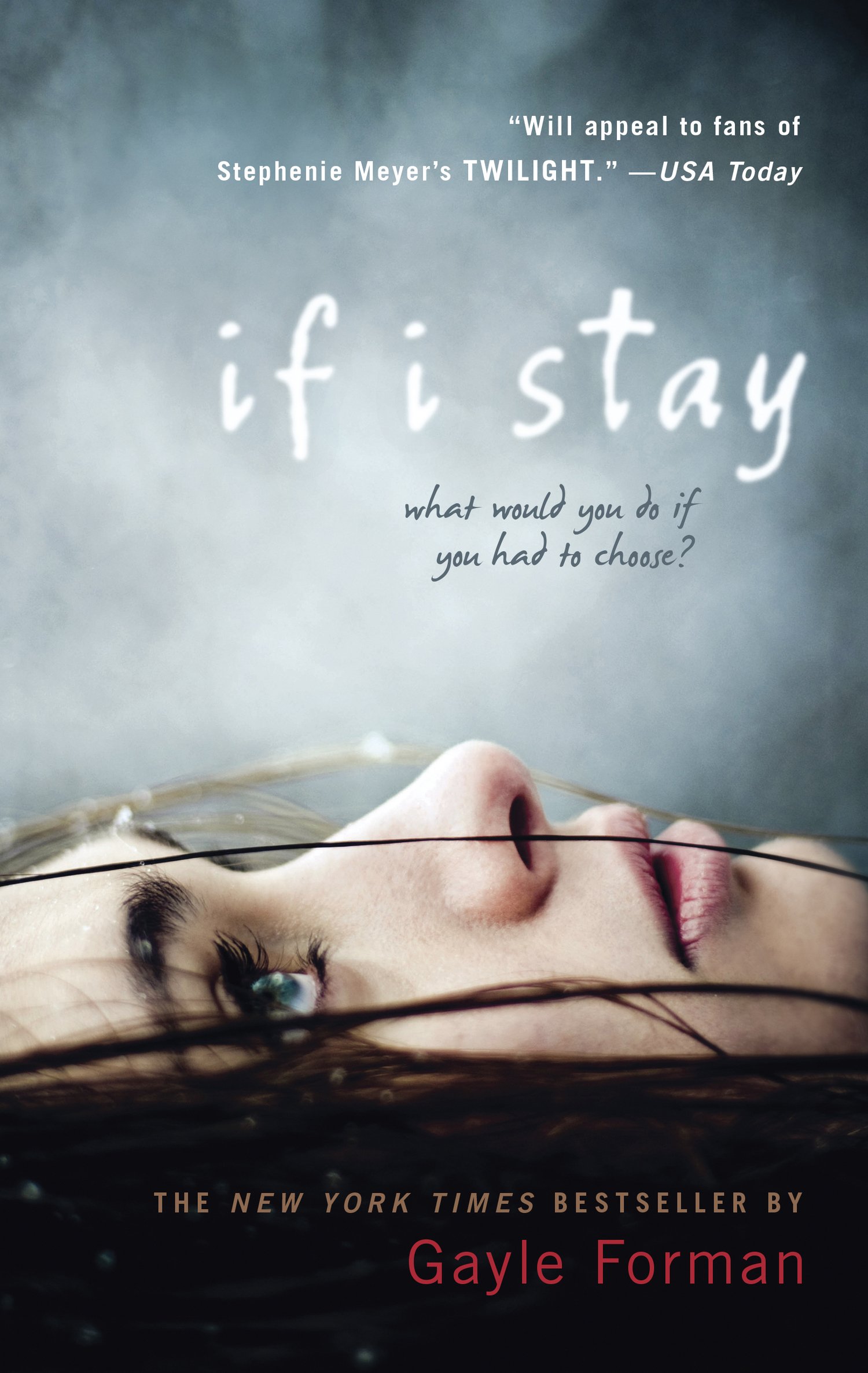
Context:

Mia is a 17-year-old high school senior and cello prodigy. She has her whole life in front of her--she's been accepted to Julliard, she has a great boyfriend, and life is just starting when she's involved in a car wreck that claims the lives of her parents and young brother. Mia then has an out-of-body experience where she observes her family and friends and she must make the decision whether she stays on Earth with them or lets go and moves on.


My thoughts:

Sigh. Okay. My main issue with this book is that it's so predictable. Of course Adam's love for Mia saves her in the end. Of course Mia is a teenage heroine who is "so different" from other teenage girls.  The symbolism her memories of the past represent pretty much slaps you in the face, never letting you figure out the themes for yourself.

I think I would have preferred this novel as a sequel to a novel that follows Mia in her pre-tragedy life only. Forman has to set up so much back story that you start feeling like she's telling the wrong story. I do enjoy some of those memories, which is one of Forman's strengths; she is good at writing poignant familial moments. Sometimes the dialogue feels forced, however. Especially in the beginning of the novel, I had a hard time believing in Mia's "cool, hip" parents. Their dialogue made me feel like I was watching one of those really bad car commercials where the actors are smiling but their dialogue is clipped and cheesy, and you can tell they're reading from a prompter. It did get better as the novel progressed, though. I ended up liking her parents, but it took half the book for me to feel comfortable with them.

I do like that it's not a stereotypical ghost story. Mia can't walk through walls or magically appear in other places when she's having her out of body experience. The novel also surprised me in its gruesomeness. The car wreck was pretty intense; I mean, her father's brain peppers the road. Though I am a little disturbed by her lack of response to that. She kind of...observes the cauliflower-like pieces of brain scattered about and....doesn't react? Pretty sure that if I saw my dad's brains decorating the pavement I'd probably...scream? Cry? Faint? I realize she was a spirit at this point but some type of reaction other than mere observance would have been more believable.

I do like that Mia seems mature for her age. She's not your Twilight Bella flinging herself off a cliff and parkouring through courtyards in Italy in her love induced craze. She and Adam seem to have a mature relationship, and I was impressed with how Mia is very self-aware; she realizes that some of her behaviors are unhealthy and unfair and she takes steps to change. She works for her relationship. I can admire that.

I also like her obsession with music. I wonder (and am too lazy to Google and find out) if Forman was a musician, because her prose regarding Mia and her connection with the cello and music is absolutely gorgeous.

My Rating:
On a scale of 1-5, I give If I Stay a 2

Forman writes beautiful memory and music scenes, but falters in creating a believable family and characters that the audience can connect to. The plot meanders through present day and memories, never becoming cohesive enough to give the novel purpose. Though there are some emotional scenes that cause brief teary-eyed moments, it's not enough to make up for the cheesy dialogue and painfully predictable YA tropes.

Thursday, January 2, 2014

Book 1 -- The Girl Who Played With Fire by Stieg Larsson, Part 2

Um. So I finished The Girl Who Played With Fire tonight.

Why couldn't the ENTIRE BOOK have been as exciting as Part 4?


Here come the spoilers!

In Part 4, everything finally gets tied up. We finally learn who Zalachenko is (him being her dad was one of those semi-surprising yet not impressive mystery story twists I mentioned last post) and how he is connected to Nils Bjurman, Dag Svensson, and Mia Johansson. We also learn who murdered the latter three persons--Lisbeth's half brother?? Okay, maybe that one did catch me a bit off guard. And wow--the ending! Suitable that a person as violent as Lisbeth would encounter such a grisly almost-but-not-quite-end. So here's a more organized list of my likes and dislikes from Part 4.

Lisbeth Salander in general: I think it goes without saying that Salander is a total bad ass. I love Katniss Everdeen and Princess Merida, but Lisbeth Salander would make them (and other YA heroines) piss their panties and run away screaming. I love her cocky attitude, and I was happy that she was immediately reintroduced in Part Four. The very first page of Part Four gives us this beautiful quip:

"She was irritated by the passport photograph that appeared everywhere. She looked stupid."

No, she's not upset that she's being hunted for a crime she didn't commit, that her name is being slandered and sullied in the media; she's pissed off about her freaking passport photograph. I find that endearing.

I find that we finally get to see Lisbeth explore her potential in this book. Yes, we know from Dragon Tattoo that she is not to be taken lightly, but that book is focused more on Mikael Blomkvist and how Lisbeth comes to be in his life, and ultimately how she fixes his life. Fire focuses more on Lisbeth; her past, her problems, and the people that sculpted her into her slightly sociopathic, anti-social self. Her back story is infinitely fascinating, and it was wonderful to finally explore her character in depth.

Especially in the scene where she confronts Sandstrom--it's so interesting to see a "normal" person's reaction to her. The beauty of Larsson's writing skill comes in that he makes the audience sympathetic to a very unsympathetic person. He shows the audience the corruption of the judicial and social welfare systems, and shows what it is like to be one of those people that society shoves aside and treats with contempt. The audience sees Salander's motives, her past, her present, most of the actions she makes--the "normal" characters (police officers, other journalists, etc.) never get that advantage. Larsson invites the audience to peek behind the veil that covers the mind of a "crazy" person--and I think most readers will find themselves surprised to be on Lisbeth's side through the whole thing.

Because let's be honest, if some girl with her face painted up barged into your house, Tasered you, strung you up by your neck, and threatened to kill you if you didn't answer her questions to her satisfaction, you probably wouldn't have much sympathy for her, no matter what her childhood was like. Knowing all the details though (Salander's experience with rapists, the fact that Sandstrom is a rapist, the connection between Sandstrom and her violent father) helps clarify the picture. Life is not black and white, kids!

Additionally--another fun Salander-ism: "No security system is a match for a stupid employee." Hee.

All the Evil: Ehhhh. I kind of expected All the Evil to be something...bigger, I guess? I mean I guess it's a pretty big deal that Lisbeth tried to kill her father when she was only 12 years old, but considering all the rape, sadism, corruption, violence and scandal that the audience is introduced to over the course of Dragon Tattoo and Fire, it seems a bit underwhelming. Also, it seems I was mostly wrong about my Prologue/All the Evil assumption. I was right that it was Salander, but it seems that the Prologue was showing when Teleborian had her locked away in isolation at St. Stefan's and she was imagining the joy she got from lighting her father on fire to get her through that torture. ... Yikes.

Bjurman: Don't get me wrong, I hate Bjurman. I'm so glad he was killed. Thank you Larsson, for dispensing merciless justice to at least one rapist asshole. However, I like that he became a fairly important character in the series. I never really saw that coming--after the whole rape fiasco, I assumed Lisbeth had him quite firmly by the balls and he wouldn't be a big issue down the road. Wrong. So very, very wrong. Oh, and speaking of which, Blomkvist finding the rape DVD kind of destroyed my heart. He obviously loves Salander (though these novels are not a love story by any means--I'm in no way expecting a tender kiss and a fairytale ending come Hornet's Nest), and for him to sit there and watch something so abhorrent happen to her, only a few hours after learning about Zala being her father and all the mind-fuckery involved with the Bjorck/Security Police/Bjurman/Zala/Teleborian..um..pentagon?? ...just made me hurt so bad for him.

Action Scenes: Larsson bores me to death with his police/finance/journalism jargon, but my God, when that man writes an action scene, he absolutely kills it. The whole confrontation between Lisbeth, her father (Zala), and her half-brother (Ronald) had me reading at top speed, practically bouncing in my seat as I sped-read through to the end. I definitely did not expect her to get shot up or buried alive. I also really liked Ronald's reaction to her coming back "from the dead"--in fact, I like the way Larsson treated Ronald in general. The poor kid. He's a victim of nature AND nurture. And, despite his terrifying build and bewildering resistance to pain, he's still scared of the dark. Aww.

Also: Roberto boxing with Ronald was just mind blowingly awesome. Period. Poor Miriam, though. I hope she and Salander get to reconcile in the future.

My Rating:
On a scale of 1-5, I give The Girl Who Played With Fire a 3.5
Larsson is an incredible author. He is intelligent, thorough, and imaginative. He has a mission to expose the slimy corruption of institutes most people think they can trust, and he executes it vividly and precisely. However, at times the plot seems to drag. The police investigation is slow going, and the reader must wade through pages and pages of unending character stupidity before being rewarded with Salander's return. Names and places get lost among a mire of similar sounding names and places, and tiny details clutter up and choke the important events.

Thank you for reading! If you have any book recommendations or suggestions on how I can make this blog better, please comment and let me know. :)

Wednesday, January 1, 2014

Book 1 -- The Girl Who Played With Fire by Stieg Larsson, Part 1

Good evening! This post kind of feels like cheating, because I actually began this book last year. My best friend gave me the Millenium Trilogy (the books that inspired the movie The Girl With the Dragon Tattoo starring Rooney Mara and Daniel Craig) as a present, and it's been slow going.

I'm not big into mystery/crime novels. I've found (and mostly been proven right, as you will soon see) that they tend to focus on very specific underground worlds and use a lot of jargon. And no matter how skillfully crafted, I'm rarely impressed by the "big reveal," because regardless of what the reveal is, I know a reveal is coming. Mystery/crime authors are always trying to find newer, more impressive ways to shroud the real perpetrator in a dense fog before supposedly BLOWING YOUR MIND with their oh-so-creative and fantastical reveal. So even if I am surprised by the outcome, I'm rarely impressed, because I knew something like that would happen anyway.

But on to the Millenium Trilogy.


Context (Spoilers ahead!):

This novel is the sequel to The Girl With the Dragon Tattoo, wherein Lisbeth Salander (a social outcast and brilliant computer hacker) and Mikael Blomkvist (a disgraced journalist victimized by a large financial corporation whose illegal practices he attempts to publicize) solved a long-dead mystery involving a wealthy businessman's presumed dead granddaughter.
Salander, feeling betrayed after deciding her uncharacteristic trust in Blomkvist has been betrayed, has fled Sweden and spends a year traveling. Blomkvist becomes entangled in a big story intended to reveal big name sex offenders that his magazine, Millenium, intends to publish. However, the couple writing the story is brutally murdered in their home...and Lisbeth Salander is somehow connected and named prime suspect. Did Lisbeth Salander murder Dag Svensson and Mia Johansson? Blomkvist doesn't think so, and sets out to prove it. Meanwhile, Salander's guardian (who is also her rapist) also turns up dead, casting further scrutiny on Salander's involvement.

My Thoughts:

So far, I've read three of the four parts of the novel. Part 2 will focus on the ending, which takes up a good chunk of the novel.

First, I'd like to point out how much I admire the blurbs that introduce each part. Each one is from Fermat's Last Theorem, and, well, I hate math. I understand the blurbs enough to understand that they are clever metaphors, referencing "irregular equations," "equality", "unknowns", and "absurdities," all of which are obviously meant to illustrate not only Salander's strange hobby of obscure mathematics, but Salander herself, an absurdity to those who encounter her, an irregular occurrence in their structured lives.

I also deeply admire Larsson's  intelligence and dedication. Especially after reading Dragon Tattoo, the breadth of his knowledge and the level of research the audience must presume he tackled is staggering. He easily and with great detail explains real historical events and geography of Sweden, financial corporations and their various ways of illegally obtaining money, the industry of journalism, the inner workings of the Swedish police force, and Salander's computer hacking abilities--on top of weaving a pretty solid mystery. Larsson could write the "for dummies" book on all of these topics.

The flip side to all that research is that occasionally I found certain elements of the book hard to follow. Some Swedish words look like my cat sat on my keyboard for a few seconds, and that made it hard to keep up with different locations and character names. I don't mean that to sound xenophobic--I am just not familiar with words like "Zinkensdamm", "Sivarnandan", "Zalachenko", and "Enskede." Sweden is not a locale I've visited frequently in my literary adventures, and so the Swedish language has escaped my notice.

Not only does the Swedish language require some adjusting to, but a lot of the jargon goes way beyond anything I've encountered before. More so in Dragon Tattoo, but certainly still present in Fire, there is a swamp of financial, judicial, and criminal jargon to wade through. It occasionally makes me feel like I'm reading a textbook, and takes away from my enjoyment of the novel. While I understand that it is necessary in this type of novel, it's what I meant when I said earlier that mystery and crime novels tend to be filled with very specific vocabulary that I don't always comprehend.

The benefit of that vocabulary is evident in the realism of the novel. I love how Larsson shows how nasty the police force can be. It's so easy in our modern society to shove police corruption in an infrequently visited closet, and what little is publicized usually gets chalked up to media sensationalism. One of the police officers on Salander's tale is blatantly sexist and homophobic. One of the other officers leaks information to the press. Also, part of Dag Svensson's report on sex crimes involves revealing the names of upstanding and prominent members of the Swedish police force.

Larsson also does not shy away from sex crimes, a matter he addresses in both Dragon Tattoo and Fire. From Salander's multiple sexual relationships and her rape, to the sex crimes committed by the villain of Dragon Tattoo, to the sex trafficking problem in Fire, Larsson gives gut churning descriptions of all the blood chilling violence these crimes create. And while it can be uncomfortable to read, I believe that Larsson viewed it as necessary. Larsson was a political activist who believed in equal rights, and I think he wanted to slap people with the brutal realism of what these crimes are like for the victims. Let me tell you, he hits hard.

I found the way he set up the premise for the second installment enthralling, if not a bit predictable. The prologue introduces us to a girl, captured and restrained in a dark room by an unknown man. She deals with her torture by imagining lighting a man (presumably her captor, but the text is ambiguous) on fire. Once Lisbeth Salander makes reference to "All the Evil" in her mysterious past later on, I immediately presumed it was her in the prologue. I could be wrong, but I'll let you know once I reach the end. (:

After this, we watch Salander a while longer, until she returns to Sweden. Once there, we get a mixed bag of Blomkvist and Salander's experiences--Salander getting a new apartment, Blomkvist meeting Dag and Mia, Salander visiting her first guardian in the hospital, etc.--until the murders happen. And then Salander is gone. For the entirety of Part 3, we hear nary a word from her. I'm hoping she resurfaces quickly in Part 4, because while waiting to hear from her has kept me on the edge of my figurative seat, I find the police officers stupid, annoying, and slow. Come back Lisbeth! You're so funny and edgy and different, and these police officers are actual idiots!

Whew! Remind me to work on not sounding like I'm writing an essay so much. I'm really quite an entertaining person, but whenever I write about literature I almost immediately go into "paper writing" mode.

Stay tuned for part 2!

Welcome!

Hello and welcome to the Fifty Book Project! My name is Christy, and I'm a book lover who has lost her way.

Let's be honest--there are tons of amazing television shows on. Doctor Who, Sherlock, Supernatural, The Walking Dead, and Once Upon a Time are just a sampling of the fantasy worlds that occupy a large amount of my time. But in between the zombies, the fairytale characters, and the time traveling, I haven't picked up a book in ages. The last time I remember getting so excited about a book that I just couldn't put it down was when I read the Hunger Games (and I read that for the first time about 2 years ago).

This has prompted me to resolve to read more in 2014. My original goal was 100 books, but considering everything that's going on in my life, I think 50 is still crazy but slightly more manageable.

So a little more about me--I'm 23 and working towards a Master's degree in secondary education. Classes actually start a week from today, and I'm really excited to get started! I already have a Bachelor's in English, and I have to say, when picking a major in college--go for what excites you! I had so much fun in my upper level English classes, and I wouldn't trade that for any high-powered lawyer job or fancy doctor's position in the world (though my parents sure wish I would).

I also have a full-time, soon to be part-time, job, and am engaged to the most amazing man in the world. :) Our wedding will probably  happen in late 2015, so much of the planning will probably start happening during my second and third semesters this year.

So there you go! Join me as I journey through different genres and worlds this year. First book should be coming soon!