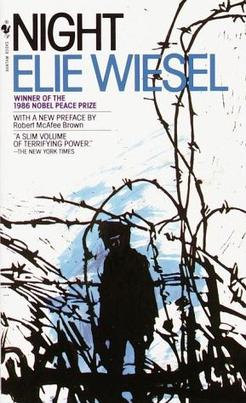
So my third book: Night
Context:
Elie Wiesel was 15 years old when his Jewish family was uprooted and dragged off to a concentration camp. This short but powerful autobiography chronicles his personal struggles and the horrifying abuses he endured by the Nazi party.
My thoughts:
I really enjoyed reading this autobiography. It's one of my favorite Holocaust books I've read. It's personal--unlike popular favorites like The Diary of Anne Frank, you get to see behind the fence and truly experience the horror. The title, "Night," is a perfect descriptor for the narrative--not only is it dark and terrifying, but the words "Night had fallen" are repeated numerous times throughout the semi-memoir. Elie is constantly aware of the night--physically and metaphorically. It's also symbolic of how he loses his faith in God--his faith becomes dark and silent.
I was moved by his relationship with his father. It's interesting to see how so many boys turn on their fathers (one murders his father for a scrap of bread), but Eliezer stands by him until his horrific death. He refuses to leave him; no matter what happens, he's constantly thinking, "Where's my father?" As Elie states, it's easy to abandon all sense of humanity when your basic needs aren't being met; but for him, his father was his main reason for surviving.
It's also stunning to hear of the abuses the Nazis heaped on the Jews. Everyone knows that it was awful, but I believe we've become numb to what those horrors were like. We know they were experimented on, tortured, beaten, and starved, but it's too easy to remove ourselves from that since the vast majority of us have probably never experienced anything like that. This work, with it's beautiful and haunting prose, brings the reader into the Holocaust. Running 42 miles, the lack of food and water, the children being burned in a pit, men being hung for minor infractions...these horrors sent shivers down my spine. You can tell the author lived these things; how else could he so painfully recollect and retell these events? And God, were they brutal. Elie's description of his wounded foot, his father's suffering in the throes of death, and the horrible conditions of the trains and the barracks made me feel sick. How could any human look at another human being and inflict these cruelties on them? I hope I never have to find out.
The religious themes are also immensely fascinating to me. Most religious people try to praise God whether things are going well for them or poorly--however, when faced with senseless persecution, it's so easy to lose faith. I can't judge them for that. How could a loving, benevolent God stand by while his "chosen people" are murdered and tortured? Eliezer's experiences force him to question the cherished beliefs he once identified with. He does not completely abandon his faith, but it's interesting to watch him and the other Jews struggle with their lot in life.
It's important to note that though I have been using Elie and Eliezer interchangeably, Elie Wiesel did change some minor details in the retelling of his story. He was silent about the Holocaust for about 10 years before he decided to write this Nobel Peace Prize winning story. This seems to be an effort on his part to continue to place some distance between himself and those events; and who can blame him? He lost everything in the Holocaust; his family, his identity, his dignity, most of his faith.
My Rating:
I give Night a 4.5/5
Elie Wiesel's autobiography is terrifying, haunting, and fascinating. His writing is absolutely gorgeous, and his emotion is tangible. Each scene leaps off the page and grabs the reader, forcing them to think about what the Holocaust actually was, as opposed to the desensitized textbook page it's usually treated as. The only reason I didn't give it a 5 was entirely personal: this book is very heavy, and left me feeling emotionally drained at the end. I would still recommend it to anyone, though.

No comments:
Post a Comment